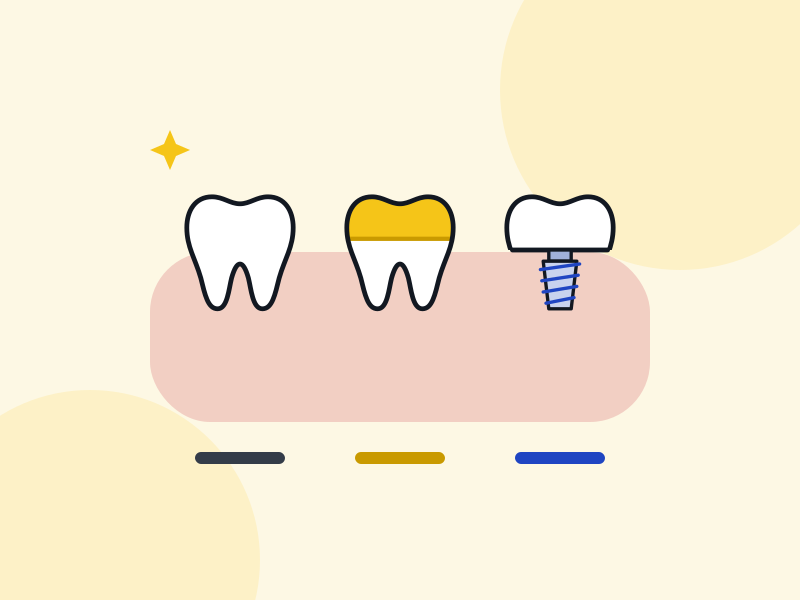
Saving a tooth with a root canal and a crown costs $870–2,660 plus $1,200–2,100 at a private practice in Australia, £300–950 plus £480–1,150 in the UK and $700–1,500 plus $800–2,500 in the US. Taking it out costs $180–350, £110–450 and $150–600 in the same countries, but the implant that replaces it costs $4,500–6,500, £1,900–3,500 and $3,000–6,000. Add the two halves of each path together and saving the tooth is the cheaper route in every country, and the faster one. Extraction is the right answer only when the tooth cannot be restored, and that is a question for your dentist, not a price list.
Path one: root canal and crown
A root canal removes the infected or dead nerve, cleans and seals the root, and is usually finished in one or two visits. A front tooth has one root and is quicker and cheaper: $800–1,400 in Australia, £260–890 in the UK and $700–1,000 in the US. A molar has three or four roots and costs more: $1,200–2,200, £580–1,000 and $1,000–1,500. Specialists (endodontists) charge towards the top of each range and are the sensible choice for a re-treatment or a curved or blocked canal.
| Country | Published range | Typical | Researched to |
|---|---|---|---|
| Australia | $870–2,660 | $1,760 | 7 Sept 2026 |
| New Zealand | $860–2,000 | $1,430 | 7 Sept 2026 |
| United Kingdom | £300–950 | £620 | 7 Sept 2026 |
| United States | $700–1,500 | $1,100 | 7 Sept 2026 |
| Canada | $720–1,760 | $1,240 | 7 Sept 2026 |
The crown is the part people forget. A root-treated back tooth is brittle and hollowed out, and teeth left with only a filling fail several times more often than teeth given a full-coverage crown. A crown is $1,200–2,100 in Australia, $1,400–2,200 in New Zealand, £480–1,150 in the UK, $800–2,500 in the US and $1,000–1,700 in Canada, and some teeth also need a post and core to hold it, quoted separately. The Root canal cost calculator adds the crown for you; the Dental crown cost calculator covers the crown alone.
The complete path is therefore root canal plus crown, finished in two to four visits over a few weeks, keeping your own root in the bone.
Path two: extraction and replacement
A simple extraction is $180–350 in Australia, $240–330 in New Zealand, £110–450 in the UK, $150–600 in the US and $120–400 in Canada. A surgical extraction, needed when the tooth is broken at the gum or the root is curved, is $300–740, $400–680, £200–390, $220–600 and $250–800. The Tooth extraction cost calculator covers both.
Then the gap has to be filled, and this is where the path gets expensive:
- An implant with crown is $4,500–6,500 in Australia, $4,500–7,500 in New Zealand, £1,900–3,500 in the UK, $3,000–6,000 in the US and $3,500–6,000 in Canada. A bone graft, often needed once a tooth has been out for a while, is extra. Timeline: two to four months of socket healing, three to six months for the implant to fuse with the bone, then a few weeks for the crown. See How much do dental implants cost.
- A three-unit bridge is $3,000–7,000 in Australia, $4,200–6,000 in New Zealand, £1,200–3,600 in the UK, $2,400–5,000 in the US and $3,000–5,200 in Canada. It is quicker and needs no surgery, but the two neighbouring teeth are ground down to carry it, which is permanent. The Dental bridge cost calculator prices it by unit.
- Nothing. The cheapest option and the worst one. Neighbouring teeth tip into the space, the opposing tooth over-erupts, bone in the gap shrinks, and chewing shifts to the other side. Studies link extraction without replacement to poorer quality of life, and the implant or bridge only gets harder and dearer later.
Total cost of each path
Put the halves together for your own country:
- Save the tooth: root canal (front or molar) plus crown, plus a post if needed.
- Implant path: extraction (simple or surgical) plus implant with crown, plus any graft and a scan.
- Bridge path: extraction plus a three-unit bridge.
At the midpoints, the implant path costs roughly twice the root canal path in most of the five countries; the bridge path sits between them. The gap widens further if a graft is needed. The only scenario where extraction is cheaper overall is extraction with no replacement, which is a false economy for a chewing tooth.
Lifespans and cost per year
A systematic review comparing the options found that root-treated and restored teeth and implant-supported single crowns had similar survival, around 97% at the longer follow-ups, while conventional tooth-supported bridges fell to about 82%. Other pooled data put ten-year survival of conventional bridges at roughly 89–90% and of implant crowns in the low-to-mid 90s, and root-treated teeth with crowns at 85–95%.
In plain terms: a well-done root canal and crown and a well-done implant both commonly last fifteen to twenty years or more; a bridge is typically replaced after ten to fifteen. Because the root canal path costs the least and lasts as long as the implant, its cost per year is the lowest of the three. The Dental treatment comparison calculator takes two quotes and two expected lifespans and shows cost per year for each, so you can use your own numbers rather than these averages.
Two cautions. A root canal that fails needs re-treatment or an extraction, so the implant path can still be waiting at the end, and both crowns wear and may need replacing before the root or the implant does. Neither changes the order: save first, replace later if you must.
When a tooth is not worth saving
Your dentist may recommend extraction over a root canal when:
- too little sound tooth remains above the gum to hold a crown;
- a crack runs into the root, or the root is fractured;
- the root is badly resorbed or the tooth is very mobile from advanced gum disease;
- a previous root canal and re-treatment have already failed;
- the tooth is a wisdom tooth or has no partner to bite against, so replacing it is not needed.
If none of those applies and you are being steered towards an implant, ask why, and consider a second opinion from an endodontist. Implants are excellent at replacing missing teeth; they are not better than a healthy, restorable natural tooth.
What insurance and public schemes pay
- Australia: Medicare pays nothing for adults. Extras cover with major dental typically pays a fixed benefit per item for root canals and crowns, and sometimes for implants, capped by an annual limit. Public dental clinics for concession-card holders will usually extract rather than root-treat.
- New Zealand: No public subsidy for adults. Work and Income can grant up to $1,000 a year for essential treatment including extractions and non-molar root canals, but not crowns or implants.
- UK: On the NHS a root canal is Band 2 (£76.60) and the crown is Band 3 (£332.10), both charges from April 2026 in England; an extraction is Band 2. Implants are not normally available on the NHS. A private root canal and crown is the full fee.
- US: PPO plans usually pay 50–80% of a root canal as a basic or major service and 50% of a crown or implant as major, after the deductible and within an annual maximum of about $1,000 to $2,000. The maximum means the plan covers much more of the root canal path than of the implant path.
- Canada: The Canadian Dental Care Plan covers root canals and extractions for eligible people, and crowns with preauthorisation, with a co-payment of 0%, 40% or 60% depending on family income; implants are not listed. Employer plans typically pay 80% of basic and 50% of major services up to an annual maximum.
What to do next
- Ask your dentist whether the tooth is restorable and, if so, for a written quote for the root canal and the crown together.
- If extraction is recommended, ask for the reason and a quote for the replacement, then run both paths through the Dental treatment comparison calculator using the lifespans above.
- Book the root canal soon if that is the answer. Infected teeth do not get cheaper to treat.